13 November 2026 · By Marcus O'Shaughnessy
Before the World Went Online: The 90s, Creative Freedom and an Era That Changed Everything
As Tate Britain celebrates the art, fashion and cultural rebellion of the 1990s, Imaginative Reaction reflects on a remarkable decade of originality, connection and creative freedom — and asks whether something important has been lost along the way.
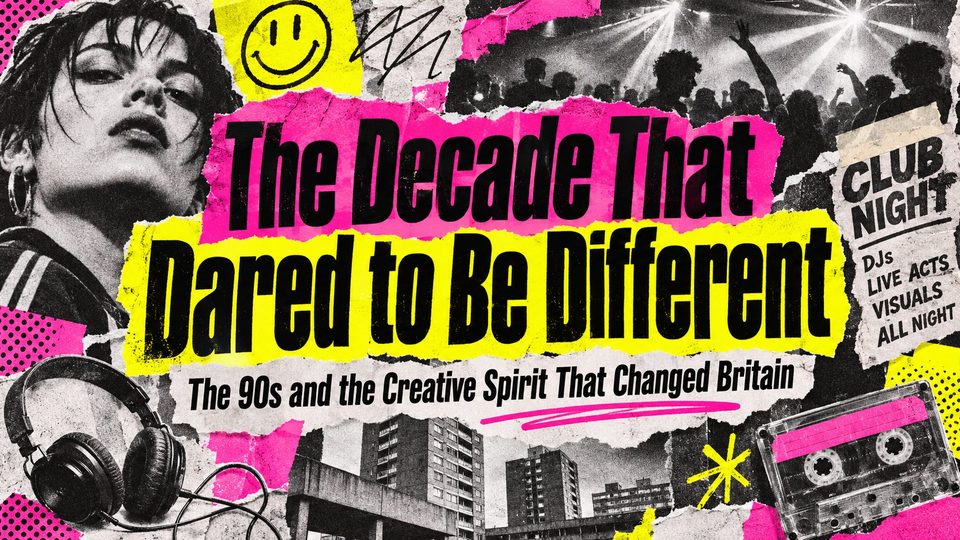
There was a time when discovering something new meant going out into the world to find it.
A new record, an underground exhibition, a handmade flyer, an independent magazine or an unexpected conversation with someone who introduced you to something extraordinary.
For those of us who grew up during the 1990s, these experiences were not simply entertainment. They helped shape who we were, what inspired us and how we connected with the world.
For me personally, the 90s represent some of the happiest and most creatively influential years of my life.
Music felt like an identity. Fashion was a statement. Art challenged established ideas, and creative communities built their own movements, often without institutional approval or substantial resources.
There was something wonderfully unpredictable about it all.
Today, we live in a world of instant communication, endless digital content, automated recommendations and increasingly sophisticated artificial intelligence.
But with that progress comes a question I find myself returning to:
Have we made creativity more accessible while somehow making the experience of discovering it feel less personal?
This is why Tate Britain's latest exhibition, The 90s: Art and Fashion, feels particularly relevant.
It offers an opportunity not only to revisit an extraordinary cultural era, but to consider what that period can teach us about originality, artistic independence and human connection.
Tate Britain: Rediscovering a Decade of Rebellion
Running from 8 October 2026 until 14 February 2027, The 90s: Art and Fashion brings together more than 100 works by nearly 70 artists, photographers and designers.
Curated by Edward Enninful OBE, the former editor-in-chief of British Vogue, alongside Tate Britain's curatorial team, the exhibition explores the intersection of art, fashion, photography and music during a period that transformed British cultural identity.
Enninful brings an especially valuable perspective. His career began within the very culture the exhibition explores, becoming fashion director of i-D magazine at just 18.
Rather than presenting the 1990s as a collection of familiar cultural references, the exhibition examines the movements and communities that helped redefine British creativity.
Fashion designers became artists in their own right. Photographers challenged conventional beauty. Musicians and club communities influenced visual culture, while young artists attracted international attention through work that was provocative, experimental and sometimes deliberately uncomfortable.
The established rules were being rewritten.
And many of those changes began not in prestigious institutions, but through friendships, independent creative networks, nightlife and a determination to do things differently.
When Originality Was a Form of Rebellion
Among the exhibition's most fascinating elements is its exploration of the Young British Artists, commonly known as the YBAs.
Figures including Damien Hirst, Sarah Lucas, Tracey Emin and Rachel Whiteread helped transform contemporary British art during the decade.
Their work challenged expectations about materials, subject matter and what could reasonably be considered art.
Whether audiences loved these works or strongly disagreed with them, they generated debate.
And perhaps that was part of their significance.
They made people question what they were looking at.
Alongside these artists, Tate presents work by photographers such as Corinne Day, Juergen Teller and David Sims, whose unconventional images helped dismantle the polished glamour of the previous decade.
Magazines including i-D and Dazed & Confused became influential creative platforms, introducing audiences to emerging perspectives and challenging established definitions of style.
Fashion designers Alexander McQueen, Vivienne Westwood, John Galliano and Hussein Chalayan similarly pushed clothing beyond commercial purpose.
Fashion became performance, cultural commentary and visual art.
For young creatives, this was a compelling message: you did not necessarily need to follow an established path to produce something culturally significant.
You needed imagination, determination and the courage to develop an identity of your own.
The Soundtrack to a Generation
For many of us, the most powerful memories of the 90s are inseparable from music.
From Britpop and hip-hop to house, jungle, garage and drum and bass, music shaped friendships, fashion and entire communities.
Record shops were places of discovery. Flyers advertised underground events. Clubs connected people through shared musical identities.
Before social media transformed how culture was promoted, movements travelled through word of mouth, radio, independent publications and physical communities.
Tate explores this world through photographs documenting legendary venues and club nights, including Manchester's Haçienda and London's Bagley's.
Photographers including Dave Swindells, Eddie Otchere, Normski, Seana Gavin and Vinca Petersen captured the energy of these communities.
Mark Leckey's 1999 film Fiorucci Made Me Hardcore offers another compelling perspective on British dance culture.
These photographs and films remind us of something that feels increasingly precious.
People participated in experiences without necessarily considering how they would appear to an online audience.
The night itself was the occasion. Not the content that might be created from it afterwards.
Friday 13 November: The 90s Come Alive at Tate Britain
To coincide with the exhibition, Tate Britain is hosting a special after-hours event on Friday 13 November 2026, from 6pm until 10pm.
Late at Tate Britain: The 90s invites visitors to experience the decade through music, performance, film, discussion and creative activity, with particular emphasis on Britain's underground rave and club culture.
DJ MILLZ brings old-school jungle and breakbeat sounds to Room 8, while underground music platform Keep Hush brings further electronic music energy to the Djanogly Café.
Screenings of Dazed's Music Nation documentaries explore musical movements that shaped British nightlife.
An immersive photographic presentation revisits Love Muscle XX, the celebrated LGBTQ+ club night associated with the Fridge in Brixton, highlighting the importance of independent spaces for identity and belonging.
Visitors can also create their own rave-flyer collages, celebrating the unmistakable handmade visual language of underground music promotion.
A discussion examining the political and social significance of 1990s music will consider how garage and jungle helped shape wider cultural conversations.
The programme also features a performance by Trinity Laban postgraduate dance students working with artist and choreographer Eve Stainton.
What particularly appeals to me about this evening is its emphasis on participation.
Rather than simply looking back at photographs, visitors can experience music, conversation, movement and creativity together.
That sense of shared experience is arguably one of the greatest things the decade has to offer.
More Than Nostalgia: The Voices That Changed British Culture
It would be easy to remember the 1990s through rose-tinted glasses.
But the decade was not without its difficulties, inequalities and divisions.
Tate's exhibition importantly explores artists who challenged those realities through their work.
Chris Ofili's extraordinary 1998 painting No Woman, No Cry, created in tribute to Doreen and Stephen Lawrence, connects artistic expression with grief, racial injustice and the power of representation.
Work by Steve McQueen, Yinka Shonibare, Sonia Boyce and other influential artists broadens the story beyond the familiar narrative of 'Cool Britannia'.
The exhibition also considers how Black British designers, photographers and creative communities challenged the limitations of established institutions.
For many, art was not simply a celebration of freedom. It was also a means of demanding it.
The lasting value of the decade lies not in believing everything was better, but in recognising those who challenged what was accepted and created space for new perspectives.
From Analogue Discovery to Digital Everything
The 1990s were a pivotal decade in the development of the internet and technologies that would transform everyday life.
But for much of that period, being online had not yet become the default condition of our existence.
We discovered music through friends, radio and record shops. We discovered artists by visiting exhibitions, reading magazines and following personal recommendations.
Creative work often circulated gradually.
There was space for anticipation, exploration and surprise.
Today, almost any song, image, film or artistic reference can be accessed within seconds.
This accessibility has created extraordinary opportunities for artists to connect internationally, build independent businesses and share their work without relying on traditional gatekeepers.
Yet I sometimes wonder whether the sheer volume of material we consume has changed our relationship with creativity itself.
When trends travel around the world almost instantly, and algorithms continuously suggest what we should engage with next, there can be pressure to follow what is already successful.
The danger is not that originality has disappeared.
It is that original voices can become harder to hear beneath the constant noise.
The most influential creative movements rarely began by asking what an algorithm wanted. They began with people making something they believed in.
Why This Matters to Imaginative Reaction — And Where Our Story Began
For me, this exhibition has a particularly meaningful connection to the origins of Imaginative Reaction.
During the 1990s, Nick Fraser was creating paintings of his own, developing his artistic expression during the very era whose culture and creativity Tate is now celebrating.
Nick's story would eventually become an important part of the inspiration behind Imaginative Reaction.
What began through an appreciation of his creative journey helped inspire a wider ambition: to champion artists, celebrate their individuality and create opportunities for work that deserves to be seen.
There is something powerful about reflecting on paintings created more than three decades ago and recognising that their influence can continue far beyond the moment they were made.
It reminds us that the true value of creativity cannot always be measured by immediate recognition, commercial success or contemporary popularity.
Sometimes the significance of an artist's work becomes clearer with time. Sometimes it is rediscovered through new eyes, new conversations and new opportunities.
And sometimes, one artist's creative journey can become the inspiration for supporting countless others.
That sentiment remains at the heart of Imaginative Reaction.
Our belief in supporting independent artists is built around recognising individuality, encouraging creative development and creating meaningful opportunities to share original work.
Looking at the communities that emerged throughout the 1990s reinforces why this matters.
Many artists and designers whose work now fills major galleries began through experimentation, collaboration, limited resources and unconventional ideas.
They did not necessarily know where their journeys would lead.
They simply started creating.
Creativity should never be reduced to engagement figures, follower counts or commercial trends.
It should remain a space for exploration, personal expression, discovery and the confidence to be different.
Technology will continue to transform the creative industries, and there are exciting opportunities ahead.
But the value of an original idea, a personal story or a genuine human connection cannot be measured by technology alone.
Nick Fraser's journey is a reminder of that — and of why Imaginative Reaction exists today.
An Exhibition Worth Experiencing
Whether you grew up during the 1990s or are discovering its culture for the first time, The 90s: Art and Fashion offers an opportunity to explore a decade whose creative influence continues to resonate.
For those who remember it, the experience may bring back memories of music, friendships, optimism and the sense of possibility that accompanied a remarkable cultural transition.
For younger generations, it offers insight into how artistic movements developed before today's digital platforms became central to communication.
And for contemporary artists, it provides inspiration from a generation that challenged expectations and demonstrated the importance of developing an independent creative voice.
Personally, I see this exhibition as much more than a nostalgic journey.
It is an opportunity to reflect on where our creative culture has come from, how far it has travelled and what we want to preserve as technology reshapes the future.
Perhaps we cannot recreate the feeling of growing up in the 90s.
Nor should we try to return to the past at the expense of today's opportunities.
But we can carry something of its spirit forward.
The curiosity. The spontaneity. The willingness to experiment. The courage to be different.
And above all, the understanding that creativity begins with people.
Because the future of creativity should not simply be about producing more. It should be about creating something that genuinely means more.
Plan Your Visit
The 90s: Art and Fashion
Tate Britain, Millbank, London SW1P 4RG
8 October 2026 – 14 February 2027
Standard admission: £22, with concessions available.
Late at Tate Britain: The 90s
Friday 13 November 2026, 6pm–10pm.
Free evening programme, advertised as an 18+ event. The exhibition is separately ticketed.
For further information and tickets:
Tate Britain — The 90s: Art and Fashion
Late at Tate Britain — The 90s
Written for Imaginative Reaction — Supporting creativity, individuality and the artists shaping our cultural future.
- Tate Britain
- The 90s
- : Art and Fashion
- 1990s British Art
- Contemporary Art
- British Art
- History
- Young British Artists
- 90s Fashion
- Creative Freedom
- Independent Artists
- London Art Exhibitions
- Imaginative Reaction
- Nick Fraser